

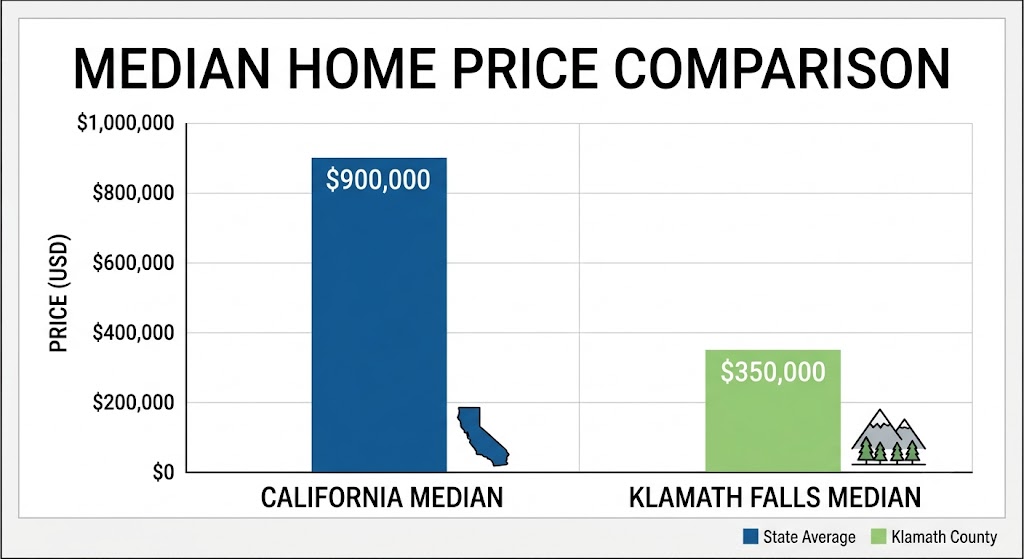
Moving from California to Klamath Falls, Oregon typically means a significantly lower home price (around $288K vs. California's $785K median) and far more stable home insurance costs, though Oregon's tax advantage depends heavily on income level and spending habits.
I get a version of the same conversation almost every week now: someone from California, looking at what their house would sell for, and doing the math on Oregon. I'm not going to give you the sales-pitch version of this. Here's the real comparison — where Klamath Falls genuinely wins, where it doesn't, and what actually matters once you dig past the headlines.
The Home Price Gap Is Real
This is usually where the conversation starts, and for good reason. Statewide, median home prices run around $785,000 in California versus roughly $480,000 in Oregon — and Klamath Falls sits well below even that Oregon number, with typical home values here around $288,000. If you're selling a California home and buying here, that gap is often the single biggest number in your whole decision.
The Tax Picture Is More Complicated Than People Assume
I want to be straight with you here, because a lot of relocation content oversimplifies this. Oregon has no sales tax at all — a genuine, everyday saving on everything from groceries to a car purchase. But Oregon's income tax isn't the slam-dunk win people expect: the top rate (9.9%) is lower than California's top rate (13.3%), but Oregon's higher brackets kick in at much lower income levels. For a lot of middle-income earners, California's graduated system can actually work out cheaper on income tax alone — the advantage shows up more clearly for high earners and for households that spend heavily enough that "no sales tax" adds up.
Property tax is a mixed bag too. Oregon's effective rate runs close to 0.82–0.97% statewide, a bit higher than California's roughly 0.71–0.76% — though California's Prop 13 protections can mean long-time CA owners are paying property tax well below what a new Oregon buyer would pay on a comparable home. The honest takeaway: don't move here for the tax math alone. Run your specific numbers, because the answer depends heavily on your income level and spending habits, not just the state you're leaving.
Where Oregon Pulls Ahead Clearly: Insurance
This is the one where I don't think there's much debate left. California's homeowners insurance market has gone through a genuine crisis. Stanford researchers found statewide premiums rose 84% between the end of 2020 and March 2026, and that's no longer confined to classic wildfire zones — it's spreading into areas that never used to worry about it. The California FAIR Plan, originally meant as a last resort, now covers a rapidly growing share of the market as major insurers have pulled back or stopped writing new policies in high-risk areas altogether.
Klamath Falls isn't immune to wildfire risk — nowhere in the West really is — but the insurance market here hasn't seen anything close to that level of disruption. If you've been non-renewed, quoted a shocking premium, or pushed into the FAIR Plan in California, that alone is worth a serious look at what coverage costs on a comparable home here.
The Trade-Offs Nobody Puts on the Brochure
Klamath Falls is a real trade — not a strictly better version of California. You're trading big-city amenities, denser job markets, and coastal or Bay Area weather for a smaller town, a real winter, and a job market concentrated in healthcare, education, and public employment. If your career is highly specialized, confirm the local opportunities line up before you commit — I go through that honestly in my complete guide to moving to Klamath Falls.
The pace of life is the other side of that trade, and it's usually the part people end up loving most once they're here — the community, the outdoor access, a commute that doesn't eat your morning.
What Actually Makes This Move Work
Sequencing matters more than almost anything else. Selling a California home and buying here at the same time is its own kind of stressful — two markets, two timelines, and the risk of getting stuck renting in between if it's not planned out. That's a conversation worth having directly with me rather than assuming a generic timeline will fit your situation.
My Honest Bottom Line
I'm not going to tell you Oregon wins on every line item, because it doesn't — the tax picture genuinely depends on your income and spending, and this isn't a bigger, better version of California. But on home prices and on insurance, the gap between here and there is real and significant right now, and for a lot of California households, that's enough to make the move worth serious consideration.
If you're weighing this seriously, let's talk through your actual numbers — your home equity, your income situation, and your timeline — rather than you guessing from a generic comparison chart. Reach out anytime.
Darlene Humphreys
Principal Broker/Owner, SCORE — South Central Oregon Real Estate
OR License #200604426